Click here to return to Brighton & Hove Local History Group's Home Page and Index

Brighton Workhouse and the Brighton Poor Research Group
 

BRIGHTON WORKHOUSE ENTERTAINMENT

 Research by Sue Carnochan


Entertainments Provided by the Sattin Family


Edward Sattin became Master of Brighton Workhouse in 1859. He maintained discipline, but had a compassionate nature. No card games were allowed, but he did introduce 'Christmas Festivities' for the inmates in his first year as 'Master'. In 1881, the Brighton Guardians proclaimed "at no institution in the town is Christmas rendered more attractive or enjoyable than at the Brighton Workhouse".


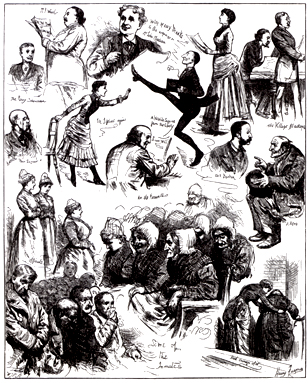
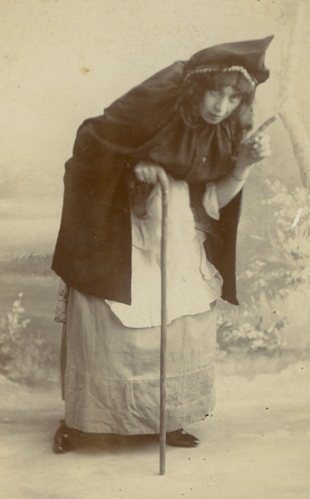
On New Year's Day, 1884, the men and women were entertained in the dining room to a farce put on by the Sattin family and visitors, entitled "The Silent Woman". The humorous drama  was followed by a musical concert in which one of the Sattin daughters sang a song "I'm Ninety Five" so realistically that she limped off to deafening applause.


Summer Treats and Concerts


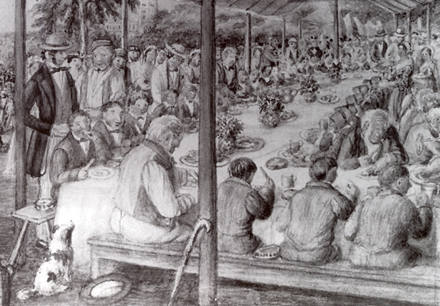
In 1889, Edward Sattin persuaded the Guardians to allow the able-bodied inmates to attend "Summer Treats. These "Summer Treats" also  included entertainment by the Sattin family and were much appreciated by everyone.


On other occasions, the Industrial Schools gave 2-hour long concerts.


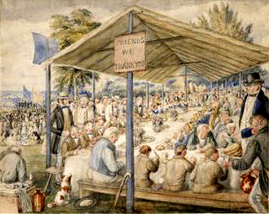
[ABOVE] Workhouse inmates enjoy a "Summer Treat"; a detail from a watercolour painting, entitled 'The Workhouse Treat', by John Henry Buckingham (1800-1881).


Edward Sattin (1825-1891), Master of Brighton Workhouse [1859-1891]

Edward Sattin was born in Brighton, Sussex, in 1825, the eldest son of Elizabeth and Edward Sattin senior, a tinplate worker and furniture broker of Edward Street, Brighton. [Edward Sattin junior was baptised at St Thomas's Church in Lewes - his father's home town - on 9th October 1825].

Edward Sattin began his working life as a "Furniture Broker" but by 1855 he was employed as a clerk at the Workhouse in Church Hill, Brighton. On 19th February 1857, Edward Sattin married Emma Dawe (born c1834, Bickleigh, Devon), the daughter of Mary and John Dawe, the Matron and Master of the Workhouse at Plympton St Mary in Devon. Emma Dawe, Edward Sattin's bride, had previously worked as a cook at the Workhouse in Totnes, Devon, but by 1857 she held the position of 'Assistant Matron' at the Brighton Workhouse.

In 1859, after the sudden departure of Edward Passmore, the former Governor of the Church Hill Workhouse, Edward Sattin, then only 34 years of age, was appointed as the new Master of Brighton Workhouse and his 25 year old wife, Mrs Emma Sattin, was promoted to the post of Matron.

During their 34 year of marriage, Mr & Mrs Sattin produced at least 6 children - Elizabeth (born 1858), Edward James (born 1859), William Harold (born 1861), Arthur (born 1863), Edith Dora (born 1864) and Beatrice Mabel Emma Sattin (born 1866).

Edward Sattin died from a influenza on 14th November 1891 at the age of 66. Shortly after Sattin's death, the Guardians raised a memorial plaque in his honour. The inscription on the brass tablet read: "In Affectionate Remembrance of EDWARD SATTIN, who for a period of 32 years was MASTER of the BRIGHTON WORKHOUSE & Possessed the Confidence & Esteem of THE GUARDIANS, by whom this Tablet is erected."

[ABOVE] Edward Sattin (1825-1891), the Master of Brighton Workhouse between 1859 and 1891.

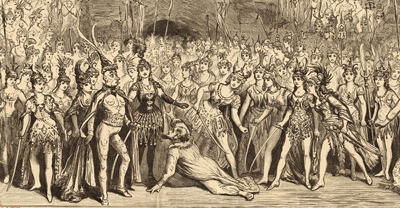
[ABOVE] A New Year's Eve Entertainment at the St Giles's Workhouse in London. (An engraving printed in the Illustrated Evening News on 12th January, 1881). It was not uncommon for Workhouse Masters to arrange concerts and other entertainments for inmates at Christmas or on New Year's Day.

The Workhouse Treat by John H. Buckingham (c1850)

PHOTO: St Albans Museums

I'm ninety-five, I'm ninety-five,

I'm ninety-five, I'm ninety-five

And to keep single,  I'll contrive;

I'm ninety-five, I'm ninety-five,

And to keep single I'll contrive;

The men all strove to gain my 'eart,

But I was blunt to Cupid's dart;

Men are so sly they wink their eye

But through that, I can plainly spy.

The men go by and they wink one eye,

It's will you marry me? No, not I;

I'm ninety-five, I'm ninety five,

And to stay single I'll contrive.


[ABOVE] The words of the Victorian comic song "I'm Ninety-Five", which one of Edward Sattin's daughter's sang at the New Year's Concert at  Brighton Workhouse on 1st January, 1884. The humorous performance of the song is thought to have originated in 1842 when Rifleman Goodall of the 1st Battalion  of the Rifle Brigade dressed up as an old woman to sing "I'm Ninety-Five" in the regimental theatre in Malta.

[ABOVE] A young woman  takes on the role of an elderly female character.  Miss Sattin, a daughter of the Master of Brighton Workhouse, dressed up as an old woman when she performed the comic song "I'm Ninety-Five" at the New Year's Concert at  Brighton Workhouse on 1st January, 1884.

 
The Annual Theatre Royal Pantomime Treat

Mrs. Nye Chart, the owner and manageress of Brighton's Theatre Royal, first offered free attendance at a pantomime performance for aged workhouse inmates and children in 1868. It was refused by the Guardians with the argument that the snow was too deep for walking to the theatre. They also argued that the inmates should not receive something which most people could not afford. One Guardian, Mr. Ireland, thought "such attractions as the theatre, would lead children into the greatest evils". However, on Monday 24th January 1876, the Guardians relented and did allow 1000 adult inmates to attend a production of "TWINKLE TWINKLE LITTLE STAR". The event was reported in the Brighton Herald and the article said that "the old folks at the workhouse were given free admission and enjoyed the treat most thoroughly."


In 1877, the pantomime staged at the Theatre Royal was "JACK AND THE BEANSTALK" This time it was a Thursday afternoon performance for the female inmates. They were "highly delighted with the entertainment" according to the Brighton Herald. Inmates looked forward to this treat and it was a highlight in their otherwise dull lives.


In 1879, the children were eventually allowed to watch the pantomime and they marched from Elm Grove to New Road behind the children's workhouse band. After each performance, occupying in the best seats in the house, the children received fruit and sweets. The adults had been given tobacco or snuff for their treat.


In 1888, on April 18th, an "Illuminated Address", signed by 8 officers and 8 inmates on behalf of all those who had attended the annual pantomime, was presented to Mrs. Nye Chart. It now hangs on the wall in the Theatre Royal on the stairs leading to the Royal Circle.


The Theatre Royal, Brighton


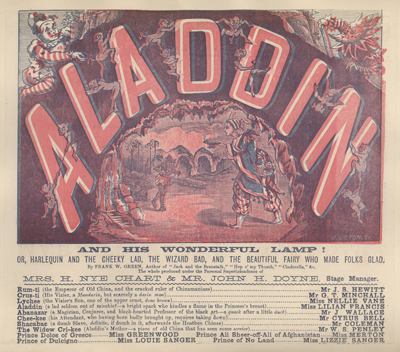
[ABOVE] A programme for the pantomime Aladdin and his Wonderful Lamp which was produced when the Theatre Royal, Brighton, was owned and managed by Mrs Ellen Nye Chart. From 1876 until her death in 1892, Mrs Ellen Nye Chart arranged for the inmates of Brighton Workhouse to attend the Theatre Royal's Annual Christmas Pantomime.

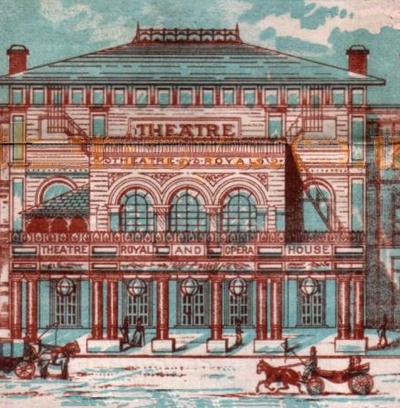
[ABOVE] A coloured woodcut depicting the Theatre Royal, Brighton in 1892. This engraving, showing the facade of the theatre, appeared as an illustration to the printed programme for the Theatre Royal's production of Aladdin and his Wonderful Lamp, one of the many Christmas Pantomimes produced by Mrs Ellen Nye Chart.

[ABOVE] A portrait of Mrs Ellen Elizabeth Nye Chart (1841-1892) from an original studio portrait by Louis Bertin of Brighton (c1875).

Born in Islington, London, around 1841, Ellen Elizabeth Rollason worked as an actress before marrying theatre manager Henry John Nye Chart in 1867. After the death of her husband in 1876,  Mrs Ellen Nye Chart, a thirty-five year old widow, took over the management of Brighton's Theatre Royal.

Mrs Ellen Nye Chart ran the Theatre Royal successfully over a period of 15 years and became a very popular figure in the town of Brighton. In particular, Mrs Nye Chart was fondly remembered by workhouse inmates because she provided them with free entry to the Annual Christmas Pantomime.

Mrs Nye Chart fell ill early in 1891 and died during a stay in London on 23rd February 1892, aged 51.

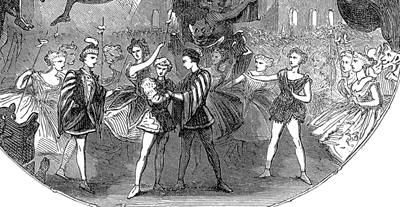
[ABOVE] Performers on the stage for a pantomime in 1866.

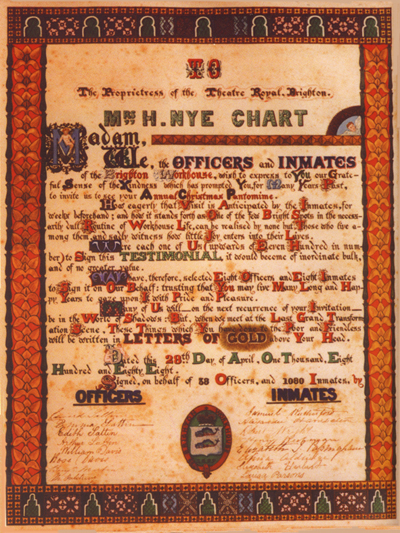
[ABOVE] The "Illuminated Testimonial" (dated  28th April, 1888) addressed to Mrs H. Nye Chart, the Proprietoress of the Theatre Royal, Brighton . [The full text of the Testimonial is reproduced on the RIGHT].

[ABOVE] A scene from a pantomime staged in 1887.  (An engraving printed in The Illustrated London News on 22nd January, 1887).

TO  The Proprietoress of the Theatre Royal, Brighton
Mrs H Nye Chart

Madam,

We the OFFICERS and INMATES
of the B
righton Workhouse wish to express to you our grateful Sense of the Kindness which has prompted You for Many Years Past to invite us to see your Annual Christmas Pantomime.

How eagerly the Visit is Anticipated by Inmates for weeks beforehand and how it stands forth as One of the few Bright Spots in the necessarily dull Routine of Workhouse Life can be realised by none but Those who live among them and sadly witness how little Joy enters into their Lives.

Were each one of Us (upwards of Eleven Hundred in number) to Sign this TESTIMONIAL, it would become of inordinate bulk and of no greater value.

WE have, therefore, selected Eight Officers and Eight Inmates to Sign on Our Behalf: trusting that You may live Many Long and Happy Years to gaze upon It with Pride and Pleasure.

Many of Us will - on the next recurrence of your Invitation - be in the World of Shadows: But when we meet at the Last Grand Transformation Scene, These Things which You have done to the Poor and Friendless will be written in LETTERS OF GOLD above Your Head.

Dated this 28th Day of April, One Thousand, Eight Hundred and Eighty Eight.

Signed on behalf of 38 Officers and 1080 Inmates, by
 

OFFICERSEdward Sattin, Emma Sattin, Edith Sattin, Arthur Sattin, William Davis, Rose Davis, Berry McMartin, Mr Patching

INMATESSamuel Rutherford, Alexander Hambelton, Robert Wright, Henry Richman, Elizabeth J. Passingham, April Aldridge, Elizabeth Herbert, Louisa Parsons

[ABOVE] The text of the "Illuminated Address", signed by 8 officers and 8 inmates of Brighton Workhouse, which was presented to Mrs. Nye Chart on 28th April, 1888, as a 'Testimonial' to her kindness and generosity.

Among the inmates who signed the Illuminated Testimonial was Samuel Rutherford (c1814-1897), a seventy-four year old former maker of musical organs, and Louisa Parsons, a twenty-four year old "needle worker" who had been an inmate since her teens.


VISITS TO OTHER PLACES OF INTEREST


The Swiss Gardens, Shoreham


Outings for the Workhouse Children


A visit to the Swiss Gardens was a treat for the children of the Brighton Workhouse in Church Hill. The young inmates first visit to the Shoreham amusement park was in 1851. The youngsters even composed a song of gratitude to their benefactors, including a line thanking the proprietor of the Swiss Gardens Amusement Park (Mr. Goodchild), who had offered free entrance to the children, and to the owners of Railway Company, who had provided free transport to the station at Shoreham. ["To our Guardians so good, first our gratitude's due; For the gentlemen, too, of the railway, three cheers."].


On a later trip to the Swiss Gardens, in 1861, the workhouse children, led by their own brass band, marched to Brighton Railway Station carrying a banner proclaiming themselves "POOR BUT HAPPY". The procession travelled down to North Street and then along Queen's Road to the railway terminus. 


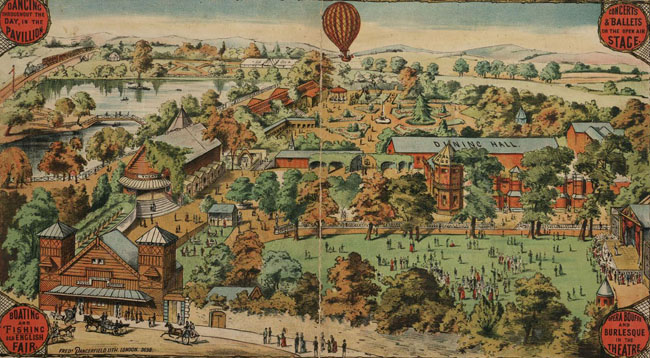
The children enjoyed 90 minutes of entertainment at the Swiss Gardens. In the amusement park there were lakes with tub-like gondolas, swings, roundabouts, see-saws, a shooting gallery, a ballroom, a theatre, magic lantern shows, bands and a photographic studio. There was also a "Mysterious Voice", emanating from a temple, predicting the future. One child fell into the lake,  but was rescued, given dry clothes and continued to be the "gayest of the gay". The children had lunch served by the Guardians and in the afternoon attended a concert in the theatre. They then had tea and races on the lawn.


In 1868, offers of free entertainment to the Circus and the Aquarium were turned down by the Guardians because they thought the workhouse children should not have treats that the working class man could not afford for their own children. Treats were confined to Happy Valley, Woodingdean, rather than the Swiss Gardens in Shoreham.


Outings for the Elderly Inmates of Brighton Workhouse


When the new Brighton Workhouse was opened in Elm Grove in 1867, some of the elderly inmates could not go to the Swiss Gardens because they could not climb up the hill at the end of the outing.


In 1872,the Guardians decided that aged inmates should no longer go to the Swiss Gardens but instead be escorted to the Tivoli Gardens, near Preston Park, primarily because no alcohol was sold there. Edward Sattin, the Master of Brighton Workhouse, recorded how disappointed the elderly inmates were and asked the Guardians to reconsider. In defence of their stance, the Guardians said that inmates returned from Shoreham DRUNK because they had access to beer and that they had even tried to get off the train to enter pubs on the way home. Some thought it didn't matter where the inmates went, "since a day's pleasure was a day's liberty from the restraints and shackles of the workhouse". In response to the proposed cancellation of the old people's outing to Shoreham, the owner of the Swiss Gardens threatened to refuse admission to the children if the adults were not allowed to attend. The motion to allow the elderly inmates to go was passed by 14-12 votes and that year they were treated to ham, lamb and beef for lunch. How they must have enjoyed it!


In 1887, Mrs Mary Haycroft, the first female Guardian to be appointed, tried to prevent the outing to the Swiss Gardens yet again. She thought the children "mixed with unsuitable acquaintances". She pointed out that some of the poor rates had to be used to pay for the treat and that some friends of the Guardians, shared the lunch, which she considered unacceptable. The motion was lost unanimously and the visit took place.


Celebratory Firework Displays


In 1887, subscriptions were raised to pay for FIREWORKS to celebrate Queen Victoria's Diamond Jubilee and these were watched by all at the workhouse.


So, in conclusion, although entertainments were few and far between, those that were  arranged for the workhouse residents  must have been  much appreciated as a pleasant interlude in their otherwise bleak existence. . .     


[ABOVE] A coloured lithographic poster advertising The Swiss Gardens, Shoreham (c1875)


The Swiss Gardens, Shoreham

The Swiss Gardens was an amusement park in Shoreham, a seaport town situated six miles west of Brighton. The Swiss Gardens had been created in 1838 by James Britton Bailey, a wealthy shipbuilder, and became a popular pleasure resort after the main railway line reached Shoreham in 1841. The pleasure gardens, contained a Dining Hall, a Drinking Bar, a Ballroom and a Confectionery.