|
|||||
|
|||||
| Brighton Workhouse and the Brighton Poor Research Group |
|
Click here to return to Brighton & Hove Local History Group's Home Page and Index |
|
LIFE INSIDE THE WORKHOUSE |
|
A Study by Veronica Wright |
|
|||||
|
|||||
|
OVERVIEW |
|||||||||||||||||||||||||||||||||
|
|
INTRODUCTION Poverty was a huge issue in the early 19th Century. It’s cause, I believe, came from several areas: The Napoleonic War had ended in 1815 and soldiers returning home were competing for fewer jobs. The Corn Laws had increased the cost of bread and the Industrial Revolution had, in some areas, contributed to high unemployment. As a consequence, it became increasingly apparent that the existing system of 'outdoor relief' for the impoverished was outdated and too expensive. The Poor Law Act of 1834 abolished ‘out door relief‘ and chose The Workhouse, as the only support available for paupers. The Workhouse was designed as a deterrent. The so-called 'Work House Test’ applied the belief, that the deserving and undeserving poor could be distinguished by a simple rule: ‘Anyone prepared to accept relief in the workhouse must be lacking in moral determination.’ Thomas Carlisle observed: "The New Law is an announcement that he who doesn’t work, deserves not to live". A new ideology was clearly emerging which affected the way in which poverty was perceived and which was to cause hardship and deprivation for the impoverished not only at the start in the 19th century workhouse, but right up through the centuries to the present day. In looking at ‘Life Inside the Workhouse’, I would like to suggest, that the ethos of the 1834 Poor Law Act became embedded into the minds of the people who were worked (?) there and, to some, it gave overt permission to go beyond acceptable standards of decency. Conditions inside The Workhouse were deliberately meant to be harsh, but there are many recorded instances of sustained and prolonged cruelty which involved both adults and children. In conclusion, it must be said, that, on the whole, this study is looking at the negative aspect of life in The Workhouse and is therefore somewhat biased. However, I will add here that there were several advantages which should not be overlooked. Basic education for children, basic medical care, three meals per day. A bed and a uniform. I leave it the reader to identify any further imbalances in my thesis. |
|
|
|
|||||
|
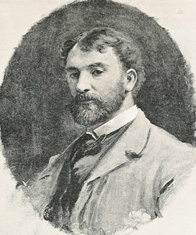
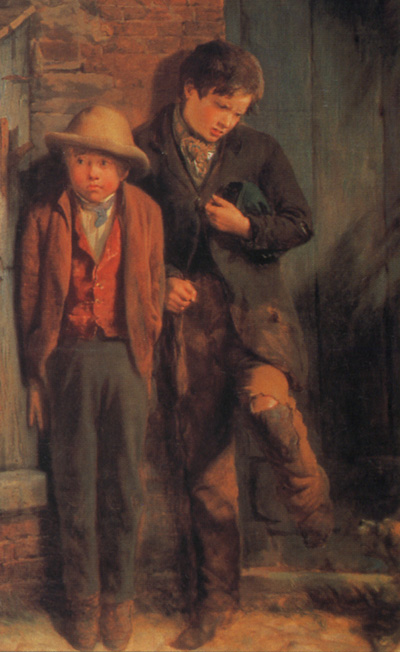
Houseless and Hungry (1869), an illustration by the Victorian artist and illustrator S. Luke Fildes (1843-1927) |
||||||
|
|
|
Two Boys Take a big leap in time and imagine you are a working class man from the 19th century. Your wife is by your side and you are standing in line outside the union work house. Circumstances have dictated your fate and like many of your friends you are without work and have lost your home. The experience, to a man, such as yours self, will be the most distressing you have ever witnessed and you resolve that your stay in this gloomy place will be short…………but………….. you have heard tales told of The New Poor Law - and too, the new workhouses…….. Moving closer you put your arm around your wife and feel her tremble with apprehension. You may well ask yourself, ‘Can this be happening ? Are we really joining the inmates of this place, known as The Bastille?’ You and your wife have just returned from the short walk from another building where you were interviewed by the Board of Guardians, for their permission, for you both to enter the workhouse. You will be expected to justify your application. As you stood in front of them with your cap in you your hand and your belly rumbling from hunger, you answered their questions as politely and honestly as you could but their tone is sharp and they seemed not to believe you, when you say you have in these past weeks, searched endlessly for work. Your attention had moved to your wife and you worried that she would faint from fatigue and you ponder, if you could ask for a chair……but something tells you not to. There are about twenty people in the line in front of you. All huddled together against the bitter cold. A few yards ahead, you can hear a child sobbing loudly. You move slightly forward and you are able to see two small boys. One about six and the other eight. "Lets go home Davy", the younger one begged as he clutched his bother's arm. The reply was weary and it was clear to see that the strain and responsibility was hard for the older boy to bear. "We have no home…how many times must I tell you? Ma has died and we have no home!" Your wife moves forward and tries to comfort the child. A man appears from behind the wall and shouts to ‘Hurry up’ and beckons for you all to move through the gates. Clutching the boys hand tightly your wife bends to speak to him but the Officer shouts "SILENCE!" The small boy, clearly terrified, continues to sob. |
|
|
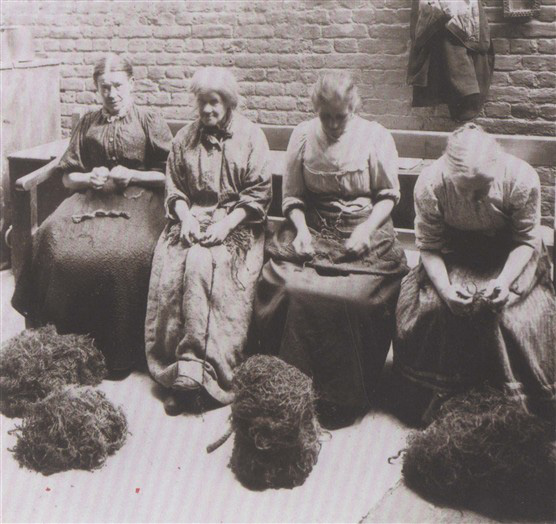
The porter leads you into an anteroom, telling you to ‘Hurry along’ and again shouts to the child to stop the noise. You hand over the authorisation forms, given to you by the Guardians. You are searched and any possessions will be taken, placed in a cupboard and logged into a book. The segregation then begins. The child holding onto your wife’s arm is snatched away and led to another section. You have no time to say good bye, as you see your wife pushed with the other women through another door. The boy’s high pitched sobbing is heard for a while - until it suddenly stops! You are marched with the other men through the main hall. The activity you encounter in the main building will no doubt surprise you. So many people, mostly staff going about their business, paying no attention to the newly formed group as it shuffles through the front door and across the main hall. Every building has its own identity and as you are marched through the corridors you become aware of the smell that looms in every corner. Tobacco, urine, damp clothes, sweat, all culminating into the smell of an institution and you would guess rightly, when you surmise, that those living and working here are not even aware of it. But to a man such as yourself, used to breathing the air of liberty, as you worked in the fields surrounding your cottage, the smell is overwhelming and clings inside your nostrils and you wonder if these people can still remember the smell of fresh hay, or cut grass or rain as it falls upon the earth and the early spring flowers as there appear in the lush green meadows. You glimpse through the open doors. In one a shoemaker is busy attending to piles of old shoes. Another room is clearly the laundry and through another you may catch a glimpse of several women working at picking oakum from old rope. Inside another you see a group of women stitching, beyond, on a table you see a stack of uniforms piled high on a table in the centre of the room. You glance outside through a window, as you are lead to the back of the house and you see a large wooden wheel as it rotates. Inmates tread from one step to another. They don’ t speak to each other as they endlessly lift their feet to the next wheel. The wheel is crunching something, perhaps corn. You eventually assemble in a large room which leads via a door at the far end. When the door swings open you realise it is a bathing area as you see several bath tubs. As you await your turn to enter this room, anger throbs with every heartbeat as you feel your pride slipping away and you wonder how your dear wife is fearing. At this point, you may well reflect on those memorable words, spoken by the great men of this Nation. Men you have admired. ‘Look at the improvements , of this great and glorious country they proclaimed, ‘New docks, cheap postage, fine railways’ look’ they say’ Sir Robert hath repealed the Corn Laws and Lord John hath drained our streets and erected baths. Oh what a blessed land this is !’ ‘Well’ you may well reply ‘That is all very good but what about the benefit it has conferred on me ?’ Here I am in this terrible place despite having worked hard all my life. My brown bread is dearer, my wages no higher. Machines have taken most of our jobs. Fine railways pass my door but I have never stepped foot in a carriage and the fast running mail cart is of no use to me. All this did not put a crumb on my table nor a stone in my cottage’ Your thoughts are interrupted by an officer, shouting your name . You are told to remove your clothes and to sit in one of the baths. The water looks as if it has been host, to the men before you. You are then given a uniform made of course material. Jacket breeches and caps. The shirt will be embolden with the letter P and a smaller letter of the Borough, of the workhouse. Your head and face will then be shaved |
Man being shaved.
|
|
The Workhouse Bell When you hear the bell for the first time it will certainly startle you. Loss of liberty you expected, but you will discover that the symbol of the bell equates, to a much more profound loss. You must never defy the sound of the bell, never underestimate it’s power, for if you do, please heed my words, you will be punished. It will be the first sound you hear at 6 in the morning and the last thing you hear when you go to bed at 8.30 in the evening. During the day the bell will inform you of everything you do. Times to work, time to eat, time to stop eating, time to wash, time to talk and time to stop talking. The strange thing about this bell is, that, with all the challenges, you are about to face, it will be it’s constant clanging which will never leave your memory. Its bid to automate your every action will endeavour to diminish who you once were. |
|
Dinner time in St Pancras Workhouse, London (1911) |
The Dining Room The dining room you will find is a cheerless (???). You are kept segregated from the women and children the elderly, insane, You have probably hoped you would at least be able to see your wife during meal times. But this is not the case. If you are lucky you may be allowed to meet with her for an hour every week but even this is not certain. The rules are strict. ‘No talking.’ The amount of food you are given is never enough and you are always left feeling hungry. The main item of food would be watered down gruel. Beer is offered instead of water owing to its poor and unhealthy quality. The small piece of cheese you are given weekly is a luxury as the strong taste is savoured in your mouth for as long as you can keep it there without swolowing.
|
|
The Privy and The Dormitory Well my friend, by now you are beginning to see what life is like inside the Union Workhouse. Before we pass on to the rules and punishment I would like to show you both the dormitory and the privy. However bad the toilet facilities, you had in your cottage at home, the communal ‘privy’ was something never to be forgotten. You will have to queue up to share with up to 200 people. It was in reality a cesspit with a cover and a hole on which to sit. The only place you could have a little privacy, if you could not stomach the stench and the long wait, was to use the dormitory bucket during the night. This of course had several drawbacks which will be left to your imagination.
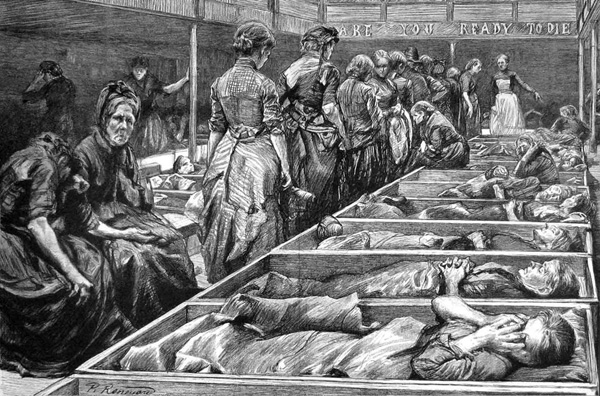
A Slop Bucket used at night for the inmates and is kept in the dormitories. The Dormitory Sometimes the beds are little more than coffins. The bedding would comprise of a flocked filled mattress with two or three thin blankets. Or if you were lucky it may be a constructed with a wooden or metal frame but usually no more than 61cm across. There could be more than twenty beds to one room. |
|